

Data 360 and Informatica MDM as the Foundation of Data Architecture
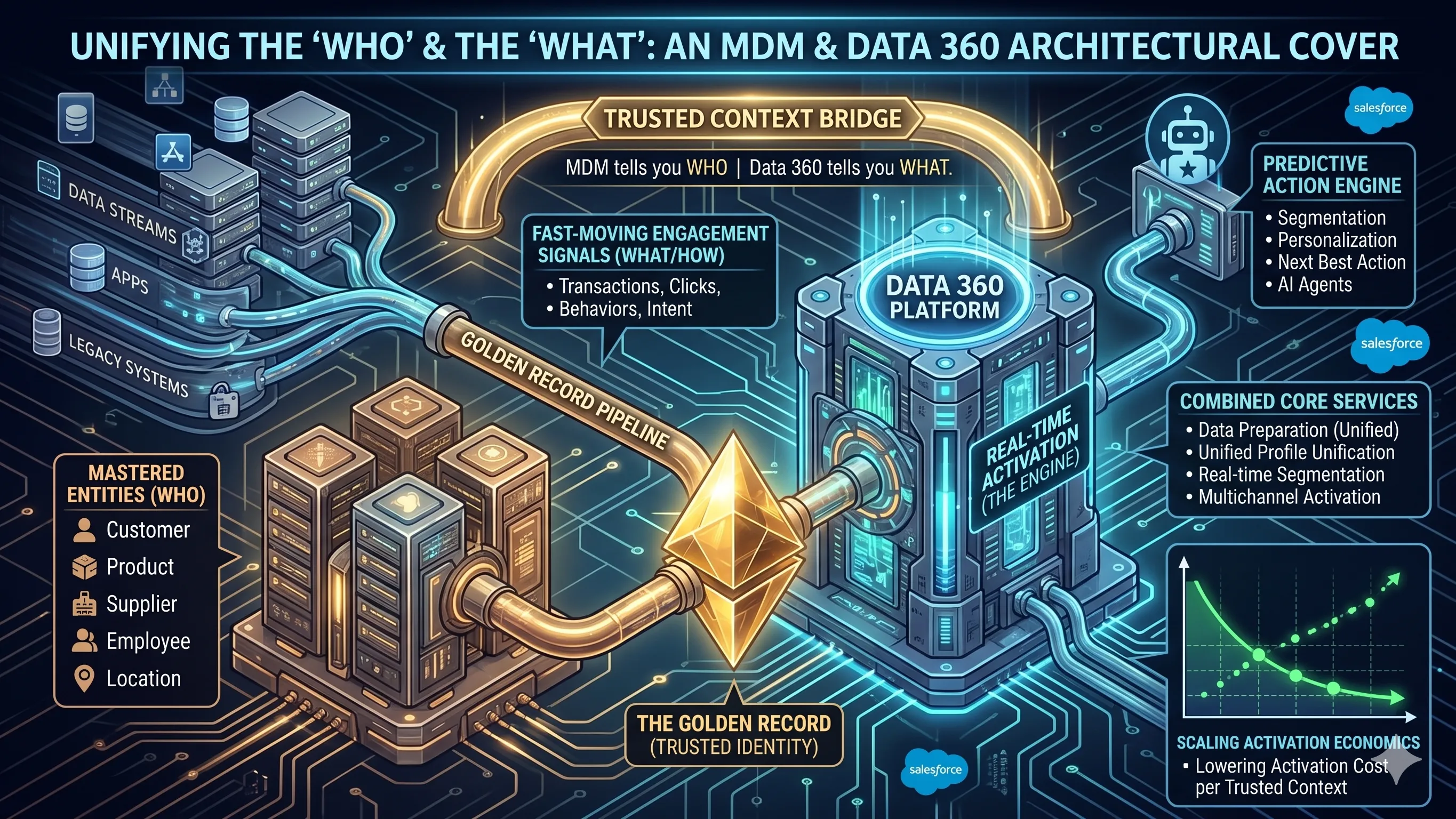
An architecture blueprint for combining Informatica MDM and Salesforce Data 360 to move from authoritative customer truth to real-time, AI-ready activation.
Architecting a modern data strategy requires moving away from the “either/or” debate between Master Data Management (MDM) and real-time activation. The real value lies in the synergy: utilizing both MDM Golden Record and high-velocity engagement signals.
Following recent deep dives at Salesforce TDX, the relationship between Informatica MDM and Salesforce Data 360 is becoming a clear architectural blueprint. Here is how these systems should work together to turn “Authoritative Truth” into “Real-Time Action.”
Informatica MDM: The Fuel (Authoritative Truth)
If you do not know who the customer is, you cannot effectively predict what they will do. Informatica MDM acts as the Trusted Data Foundation. It masters complex entities across front- and back-office systems (Salesforce, SAP, Workday, Oracle) to create a single, legally and operationally authoritative version of each business entity.
- Validated Identity: Records are verified against legal entities (DUNS, Tax IDs) rather than just being de-duplicated.
- Trust Scores: Source systems are ranked by attribute. For example, the system automatically prioritizes SAP for billing data while favoring Salesforce for contact preferences.
- Hierarchy Management: It models complex parent-child legal structures and account-to-contact relationships that standard CRM objects often struggle to maintain at scale.
Data 360: The Engine (Real-Time Activation)
While MDM provides the fuel, Salesforce Data 360 is the activation engine. It consumes the Golden Record and overlays it with fast-moving, high-volume engagement signals.
- Engagement Federation: It ingests clicks, support tickets, and browsing patterns—data that moves too fast for traditional MDM workflows.
- Propensity & Intent: By anchoring these behavioral signals to the mastered identity, Data 360 generates accurate customer insights and predictive intent signals.
- Data-Driven Workflow: It powers personalization and autonomous agents across customer and employee channels using the “Trusted Context” provided by the MDM layer.
The Architectural Pattern
From a technical standpoint, the flow follows a specific sequence to ensure data integrity without sacrificing speed:
%%{init: {'flowchart': {'nodeSpacing': 48, 'rankSpacing': 78, 'htmlLabels': true}}}%%
flowchart TB
	subgraph SOURCES[Source Systems]
		direction LR
		SF[Salesforce]
		SAP[SAP]
		OR[Oracle]
		WD[Workday]
	end

	P1{{Ingest and Cleanse}}
	INF[Informatica MDM]
	P2{{Match and Merge}}
	P3{{Publish Mastered Identity}}

	subgraph TARGETS[Consumption Systems]
		direction LR
		DLH[Data Lakehouse<br/>Snowflake, Databricks, Azure]
		D360[Salesforce Data 360]
		ACT[Agents and Downstream Systems]
	end

	ENG[Engagement Signals<br/>Clicks, Tickets, Browsing]
	P4{{Augment with Engagement and Intent}}

	SF --> P1
	SAP --> P1
	OR --> P1
	WD --> P1

	P1 --> INF
	INF --> P2
	P2 -->|Golden Record| P3
	P3 --> DLH
	P3 --> D360
	ENG --> D360
	D360 --> P4
	P4 --> ACT

	classDef system fill:#E6F0FF,stroke:#1D4ED8,color:#0F172A,stroke-width:2px;
	classDef process fill:#FEF3C7,stroke:#B45309,color:#7C2D12,stroke-width:2px,stroke-dasharray: 5 3;

	class SF,SAP,OR,WD,INF,DLH,D360,ACT,ENG system;
class P1,P2,P3,P4 process;- Preparation: Data from sources like Salesforce, SAP, or Oracle is ingested, profiled, and cleansed.
- The Master: Informatica performs the Match & Merge to produce the Golden Record.
- The Handshake: The Golden Record is pushed into the Data Lakehouse (Snowflake, Databricks, Azure, etc.) and simultaneously into Data 360.
- Activation: Data 360 takes the mastered identity from MDM and augments it with engagement signals and insights, making it ready for consumption by agents and other systems.
Why This Matters for the Enterprise
We are no longer just building reports. We are building data-driven workflows.
- Consistency: Once the Golden Record is published, every downstream system, from ERP to Marketing Cloud, operates from the same truth.
- Scalability: By offloading identity resolution and hierarchy management to Informatica, Data 360 can focus on what it does best: enrichment and activation.
Summary
The takeaway is simple: MDM should tell you who the customer is, while Data 360 should tell you how to talk to them. Informatica provides precision, Salesforce Data 360 provides speed and insights. Together they give access to the trusted context required to power the next generation of AI-driven customer experiences.
Further reading
Recommended on similar topics
If this article was useful, these posts cover adjacent patterns, implementation details, and related architecture decisions.

How to Transition from Pixel-Pusher to Code Architect
A practical guide to adopting Architecture-as-Code with Mermaid and AI, including workflow patterns, review checklists, and a migration playbook for architects.
Read About How to Transition from Pixel-Pusher to Code Architect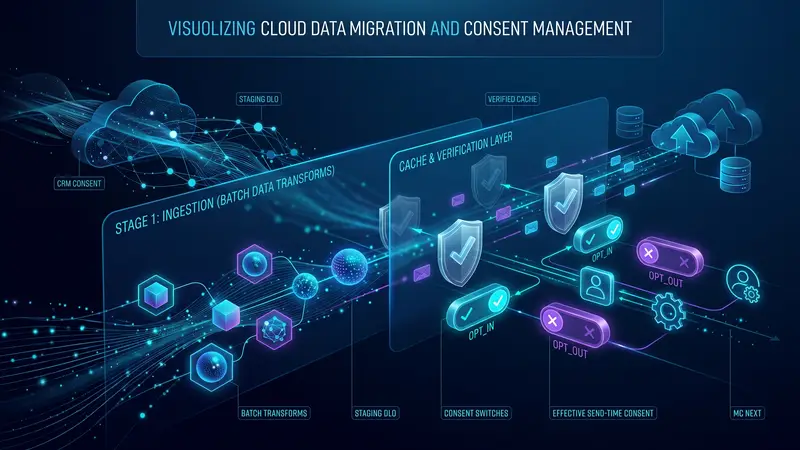
Migrating Consent from Salesforce CRM to Marketing Cloud Next: The Cache Trap
A practical migration pattern for moving existing Salesforce CRM consent into Data 360 and Marketing Cloud Next without creating a mismatch between the visible consent DMO and the state used at send time
Read About Migrating Consent from Salesforce CRM to Marketing Cloud Next: The Cache Trap